For seventy years, the official history of international drug trafficking in New York City has been written through a single, selective lens. Mainstream media, federal indictments, and Hollywood scripts have consistently framed East Harlem and the Bronx as a dual-monarchy of organized crime: Italian La Cosa Nostra on one side, operating behind institutional shields, and street-level Latino networks on the other, portrayed merely as volatile distributors.
That binary is a deliberate lie constructed by federal intelligence.
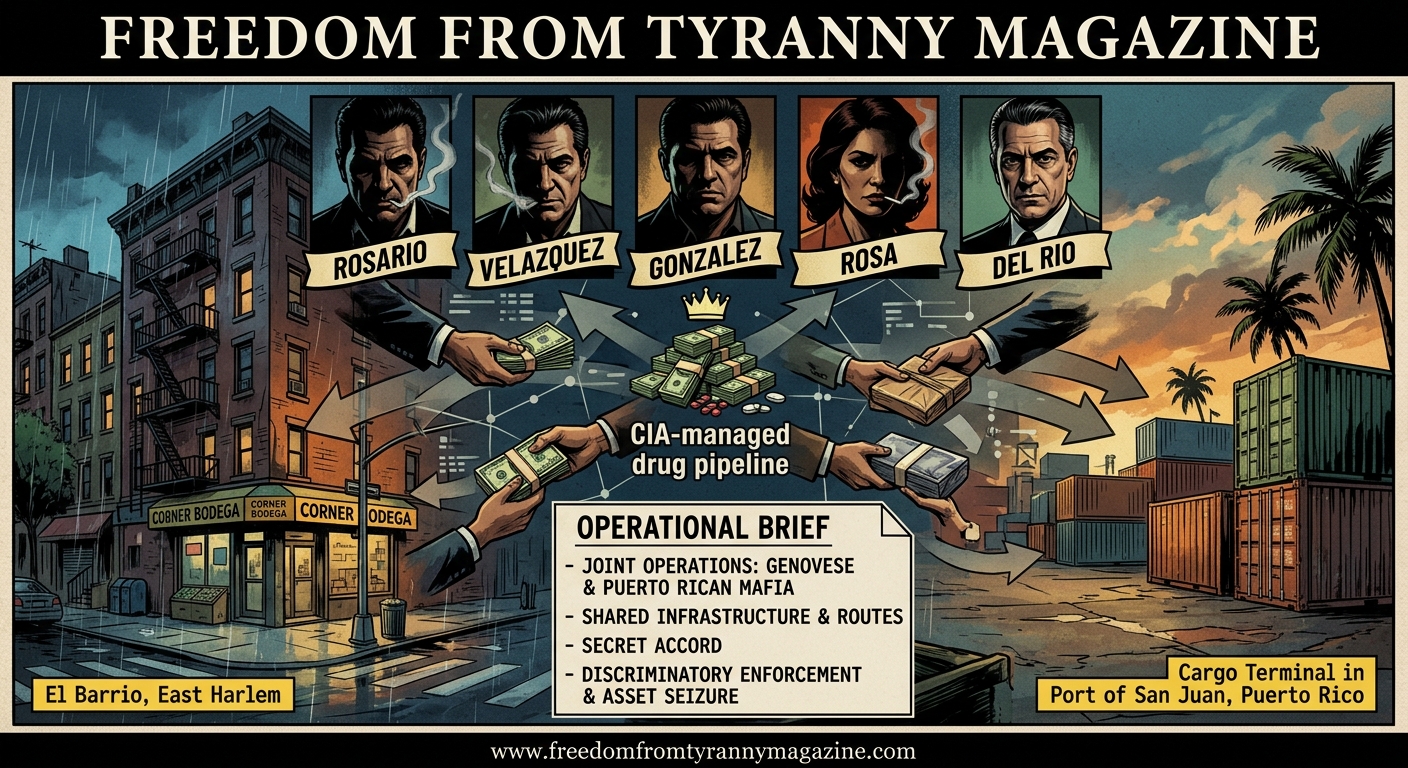
Behind the public narrative lies a sophisticated, state-sanctioned machinery: a singular CIA-managed drug pipeline operating concurrently through Italian and Puerto Rican syndicates across Harlem, the Bronx, and the Caribbean. While the Italian side operated under the protection of political structures like Father Louis Gigante’s SEBCO real estate empire, the Puerto Rican operation was organized under a parallel structure—a clandestine coalition of five prominent families moving seamlessly between San Juan and East Harlem.
These five families—the Rosarios, the Velazquezes, the Gonzalezes, the Rosas, and at the helm, the Del Rio family—served a specific geopolitical purpose for the Central Intelligence Agency. The Del Rios, occupying covert positions as the intelligence agency’s “cat’s paw,” orchestrated the logistical groundwork that transformed Puerto Rico from a Caribbean territory into an unmonitored offshore port for federal drug operations.
Yet, as recent federal enforcement actions demonstrate, the two arms of this single CIA pipeline were never treated equally.
A stark comparison between two key players—Adalberto Velazquez of the Puerto Rican syndicate and Carmine DellaCava of the Genovese crime family—reveals the racialized dynamic governing intelligence-led drug operations:
- The Puerto Rican Proxy: Indicted in 2019, Adalberto Velazquez saw his cash confiscated, his assets seized by federal marshals, and his network stripped down to zero, leaving him penniless in a federal penitentiary.
- The Italian Asset: Carmine Della Cava, the Genovese figure whose family moved multi-hundred-kilogram shipments through shared infrastructure, avoided equivalent federal destruction, allowing his family network to preserve a $50 million real estate portfolio now being fought over in state civil court.
Why are Italian syndicates permitted to launder, convert, and retain their ill-gotten gains from state-sanctioned drug pipelines, while their Puerto Rican counterparts are stripped of every cent and sent to federal prisons to die? The answer lies in the racist architecture of state-sanctioned organized crime.
I. The Island as a Black-Budget Staging Ground
To trace the origins of the Puerto Rican Mafia, one must look to the aftermath of World War II and the passage of Operation Bootstrap in the late 1940s. While Washington promoted Puerto Rico as a showcase of democratic capitalism in the Western Hemisphere, the CIA saw the island through a far more pragmatic lens: an unmonitored jurisdiction operating under U.S. customs jurisdiction, ideally positioned to finance covert actions across Latin America.
During the Cold War, the CIA required off-the-books capital to finance counter-insurgency operations, bribe foreign officials, and support right-wing paramilitary groups in Central and South America. The Caribbean was the natural transit corridor for cocaine and heroin. However, moving narcotics directly into the continental United States required reliable, controlled distribution networks.
To accomplish this, federal intelligence did not simply rely on existing Italian networks; they built a parallel pipeline run by trusted local proxies.
At the top of this hierarchy stood the Del Rio family. Operating with high-level intelligence access, the Del Rios served as the managerial anchor for four other key families:
- The Del Rios: Managed the high-level intelligence logistics, clearing federal maritime and air corridors between San Juan, Miami, and New York.
- The Rosarios: Handled maritime logistics, container routing, and port security in both San Juan and the Port of New York/New Jersey.
- The Velazquezes: Controlled wholesale storage, vehicular transport, and localized warehouse logistics across Harlem and the South Bronx.
- The Gonzalezes: Managed bulk financial routing, cash clearing, and wire integrations across Caribbean banking jurisdictions.
- The Rosas: Oversee street enforcement, territorial security, and counter-surveillance operations.
This five-family structure operated in the same physical space as the Genovese crime family in Harlem and the Bronx. They shared transit routes, utilized overlapping warehousing facilities, and relied on the same intelligence-cleared importation corridors.
Functionally, they were two branches of the exact same enterprise. Strategically, however, their ultimate fates were designed to be fundamentally different.
II. Shared Infrastructure: The Dellacava-Velazquez Connection
For decades, federal prosecutors maintained the fiction that Italian organized crime and Puerto Rican drug syndicates were bitter rivals operating in isolation. Court dockets and federal investigative files paint a completely different picture.
Central to this joint operation was the relationship between Carmine DellaCava—a long-standing Genovese associate linked to major construction, labor, and real estate interests—and Adalberto “Joe” Velazquez, who oversaw major distribution hubs in the Bronx.
The mechanics of the operation relied on shared infrastructure:
- The Supply Line: Multi-hundred-kilogram shipments of narcotics, managed under CIA-cleared maritime routes from South America through Puerto Rico, were brought directly into the New York metropolitan area.
- The Drop Points: Shipments of up to 1,000 kilograms of cocaine and heroin were routinely delivered directly to industrial warehouses nominally owned or leased by Genovese-linked holding companies.
- The Operational Control: Once inside these facilities, control of the inventory was handed directly to Adalberto Velazquez and his team, who managed packaging, vehicular distribution, and wholesale cash collection through a network of auto repair and industrial shops across the Bronx.
The Italian syndicate provided the institutional cover: properties, commercial leases, and political shields built over decades through figures like Father Louis Gigante and corporate entities like SEBCO. The Puerto Rican syndicate provided the operational labor: managing the high-risk, physical transfer of product and cash on the ground.
Both sides generated tens of millions of dollars in cash weekly. Both sides operated with the full knowledge of federal intelligence agencies, which monitored the shipments to ensure a steady stream of covert funding for international operations.
Yet, when the time came for federal law enforcement to intervene, the institutional reaction to these two groups was split down racial and structural lines.
III. The Tale of Two Operations: Forfeiture vs. Institutional Protection
The double standard of American federal justice is clearly illustrated by comparing the enforcement actions against Adalberto Velazquez and Carmine DellaCava.
The Fate of Adalberto Velazquez
In February 2019, the Southern District of New York (SDNY) unsealed a massive federal indictment against Adalberto Velazquez and his associates. The DEA and federal prosecutors labeled the operation the “Velazquez Drug Trafficking Organization,” citing the distribution of hundreds of kilograms of narcotics out of Bronx automotive facilities.
The federal response was total and destructive:
- Asset Forfeiture: Federal agents executed sweeping civil and criminal forfeiture warrants. Over $40 million in cash, real estate, personal property, and business assets were seized by the U.S. Marshals Service.
- Complete Financial Liquidation: Every bank account, holding company, and commercial property associated with the Velazquez family was frozen and seized.
- Institutional Destruction: Velazquez was sentenced to a lengthy federal prison term, completely stripped of his life’s work, leaving his family financially ruined and unable to mount sustained civil appeals.
The Fate of Carmine DellaCava and the Genovese Assets
By contrast, Carmine DellaCava and his immediate circle faced an entirely different reality. While lower-level operatives were occasionally swept up in targeted indictments, the core institutional capital generated by the Genovese side of the pipeline remained untouched.
- No Civil Asset Seizure: Federal prosecutors did not move to seize the prime commercial real estate, holding companies, or subsidized housing portfolios associated with the Italian leadership, despite clear court evidence linking these assets to decades of drug proceeds.
- Civil Court Shielding: Today, while Velazquez sits in a federal prison cell penniless, the heirs, associates, and family members of the Genovese-linked empire are engaged in a comfortable $50 million civil lawsuit in New York Supreme Court, fighting over who gets to keep the real estate portfolio.
- Generational Wealth Preservation: The federal government allowed the dirty capital generated by the Genovese side of the pipeline to be fully integrated into clean real estate, where it now generates tax-subsidized, guaranteed rental income under state protection.
IV. The Racist Doctrine of the National Security State
Why does the U.S. Department of Justice treat two arms of the exact same drug pipeline so differently?
This disparity is not an accident of law enforcement; it is a structural policy rooted in the national security state’s racialized view of criminal capital.
+-----------------------------------------------------------------------------------+
|                        THE CIA HARLEM DRUG PIPELINE                               |
+-----------------------------------------+-----------------------------------------+
                                          |
                    +---------------------+---------------------+
                    |                                           |
                    v                                           v
    +-------------------------------+           +-------------------------------+
    |     GENOVESE SYNDICATE        |           |     PUERTO RICAN SYNDICATE    |
    |  (DellaCava / Gigante Hub)   |           |  (Velazquez / Del Rio Hub)    |
    +---------------+---------------+           +---------------+---------------+
                    |                                           |
                    v                                           v
    +-------------------------------+           +-------------------------------+
    |  INSTITUTIONAL LAUNDERING     |           |  OPERATIONAL DISTRIBUTION     |
    |  - Subsidized Housing (SEBCO) |           |  - Auto Body Shops / Garages  |
    |  - Commercial Real Estate     |           |  - Bulk Cash Reserves         |
    |  - Political Patronage        |           |  - Street Logistics           |
    +---------------+---------------+           +---------------+---------------+
                    |                                           |
                    v                                           v
    +-------------------------------+           +-------------------------------+
    |   STATE-PROTECTED ASSETS      |           |   TOTAL FEDERAL DESTRUCTION   |
    |  - Civil litigation over $50M |           |  - $40M Cash/Asset Seizure    |
    |  - Zero Federal Forfeiture    |           |  - Long-Term Mass Incarceration|
    |  - Wealth handed to heirs     |           |  - Complete Bankruptcy        |
    +-------------------------------+           +-------------------------------+
The intelligence community operates on a strict racial hierarchy regarding who is permitted to hold generational wealth in America:
1. Italian Syndicates as “Stabilizing” Real Estate Partners
Since Operation Underworld in 1942, the federal government has viewed Italian organized crime as an institutional partner. Because the Mafia historically funneled its proceeds into fixed, tangible real estate—subsidized housing, union pension funds, construction companies, and political campaign funds—federal intelligence viewed them as “stabilizing” economic actors.
Allowing the Genovese family to keep $50 million in real estate preserves institutional stability in New York City politics and construction. To seize those assets would require exposing the federal grants, political payoffs, and CIA authorizations that allowed those properties to be purchased in the first place.
2. Puerto Rican Proxies as “Disposable” Labor
In contrast, Black and Latino syndicates have historically been viewed by federal intelligence as disposable operational tools. Under the colonial framework that governs U.S.-Puerto Rico relations, Puerto Rican operatives are welcomed to take the extreme physical risks of transporting product, managing street logistics, and absorbing law enforcement pressure.
However, they are strictly forbidden from converting that drug money into permanent, generational political or institutional power in New York. The moment a Puerto Rican operator like Adalberto Velazquez accumulates enough liquid cash ($40 million) to potentially buy into real estate, political infrastructure, or institutional banking, the federal government executes asset forfeiture to strip that wealth away.
3. The Colonial Wealth Extraction Model
This dynamic mirrors classic colonial extraction:
- Raw operational labor and high-risk traffic are extracted from the colony (Puerto Rico) and the inner city (East Harlem/Bronx).
- The wealth generated is processed through institutional channels.
- The white-adjacent, institutionally connected syndicate (the Italian Mob) is permitted to retain its real estate and transition into “legitimate” upper-class wealth.
- The colonial proxy (the Puerto Rican operator) is stripped of all capital, criminalized, and discarded into the federal prison system.
V. The NSA and FBI Cover-Up: Protecting the Blueprint
The refusal of the FBI, DEA, and NSA to address the connection between the Velazquez indictment and the Genovese real estate portfolio is not due to a lack of evidence. It is driven by the need to protect the blueprint of federal intelligence operations.
If federal prosecutors were forced to explain why Adalberto Velazquez’s $40 million was seized while Carmine DellaCava’s associated infrastructure was protected, they would have to open up the classified ledgers of the CIA’s Caribbean operations.
They would have to admit:
- That the warehouse network used by Velazquez was part of a decades-long joint venture cleared by federal intelligence.
- That the drug proceeds used to purchase Father Louis Gigante’s real estate empire came from the exact same supply lines that Velazquez was convicted of operating.
- That federal asset forfeiture laws are applied selectively—not based on the gravity of the crime, but based on the racial profile of the defendant and their usefulness to the national security state.
By allowing the state courts to treat the $50 million Genovese real estate battle as a private family fight, federal agencies ensure that no defense attorney can cross-examine intelligence handlers, no federal auditor can trace the origin of the purchase funds, and no civil rights attorney can expose the racial disparity inherent in federal asset seizures.
VI. A Call for Restitution and Truth
The story of the Puerto Rican Mafia is not a glorification of organized crime. It is an indictment of a federal government that uses minority communities as disposable tools for off-the-books intelligence operations, drains those communities of their wealth, and then uses the full force of federal law to ensure they remain impoverished.
The residents of East Harlem, Puerto Rico, and the South Bronx paid for this drug pipeline in human lives, addiction, and community destruction. Meanwhile, the proceeds were split: half went to finance covert federal wars abroad, and the other half was converted into prime New York real estate for connected mob families.
Freedom From Tyranny Magazine demands:
- An Immediate Federal Audit: A complete, independent investigation into the racial disparities of civil asset forfeiture actions in the Southern District of New York over the last 30 years.
- Declassification of Caribbean Pipeline Files: The immediate release of all CIA, FBI, and DEA files regarding the Del Rio, Velazquez, and Genovese operational ties in Harlem and San Juan.
- Seizure and Reparations: The immediate federal seizure of the $50 million Gigante/Genovese real estate portfolio, converting those properties into a community land trust for the people of East Harlem and the Bronx who bore the brunt of the CIA’s 70-year heroin pipeline.
The law cannot continue to protect the ill-gotten gains of preferred institutional assets while sending their colonial partners to die penniless in prison. It is time to expose the CIA’s drug pipeline for what it truly is: a mechanism of state-sponsored crime and racialized economic control.


