The American “War on Drugs” has long been presented to the public as a heroic, albeit uphill, battle between the forces of law and order and the chaotic underworld of narcotics. We are fed a steady diet of cinematic raids, massive seizures, and stern-faced officials standing behind tables piled high with shrink-wrapped cash and kilos. But for those who inhabit the fringes of society—and for those who dare to look behind the curtain of the Department of Justice—a far more sinister reality emerges.
The street-level drug trade is not a free market of independent outlaws. It is a Federally Managed Franchise.
The uncomfortable truth that mainstream media refuses to touch is this: the majority of high-volume drug dealers operating on our street corners today are not “criminals” in the traditional sense. They are Confidential Informants (CIs). They are the protected assets of the Federal Bureau of Investigation and the DEA. Under the guise of “national security” and “long-term investigations,” the FBI has effectively monopolized the drug trade, creating a closed-loop system—a Terradome—where the government decides who sells, who goes to prison, and who stays in business.
The Informant Industrial Complex
To understand how the FBI controls the streets, one must first understand the mechanics of the Confidential Informant system. In the federal playbook, a CI is more than just a snitch; they are a tool for “controlled delivery” and “proactive investigation.” However, the “control” in these operations is often a polite fiction.
When a seasoned dealer is caught, they are presented with a choice that isn’t really a choice: spend thirty years in a federal penitentiary or become a “working” asset for the Bureau. The vast majority choose the latter. Once they flip, they don’t stop dealing drugs. In fact, they often expand their operations.
The License to Deal
The FBI allows these informants to continue their illegal activities under the legal umbrella of “Otherwise Illegal Activity” (OIA). This is a formal authorization that permits an informant to engage in crimes—including drug trafficking—to maintain their cover and “gather evidence.”
In practice, this creates a class of protected predators. These informants are given a “green light” to run rampant. They move product, destroy neighborhoods, and ruin lives, all while their handlers at the FBI look the other way. The logic is that these small-scale evils will eventually lead to a “bigger fish.” But the bigger fish are almost always other informants, and the cycle continues indefinitely.
Entering the Terradome: The Trap for the Newbie
The FBI’s monopoly relies on the elimination of competition. This is where the “War on Drugs” actually functions as a corporate hostile takeover.
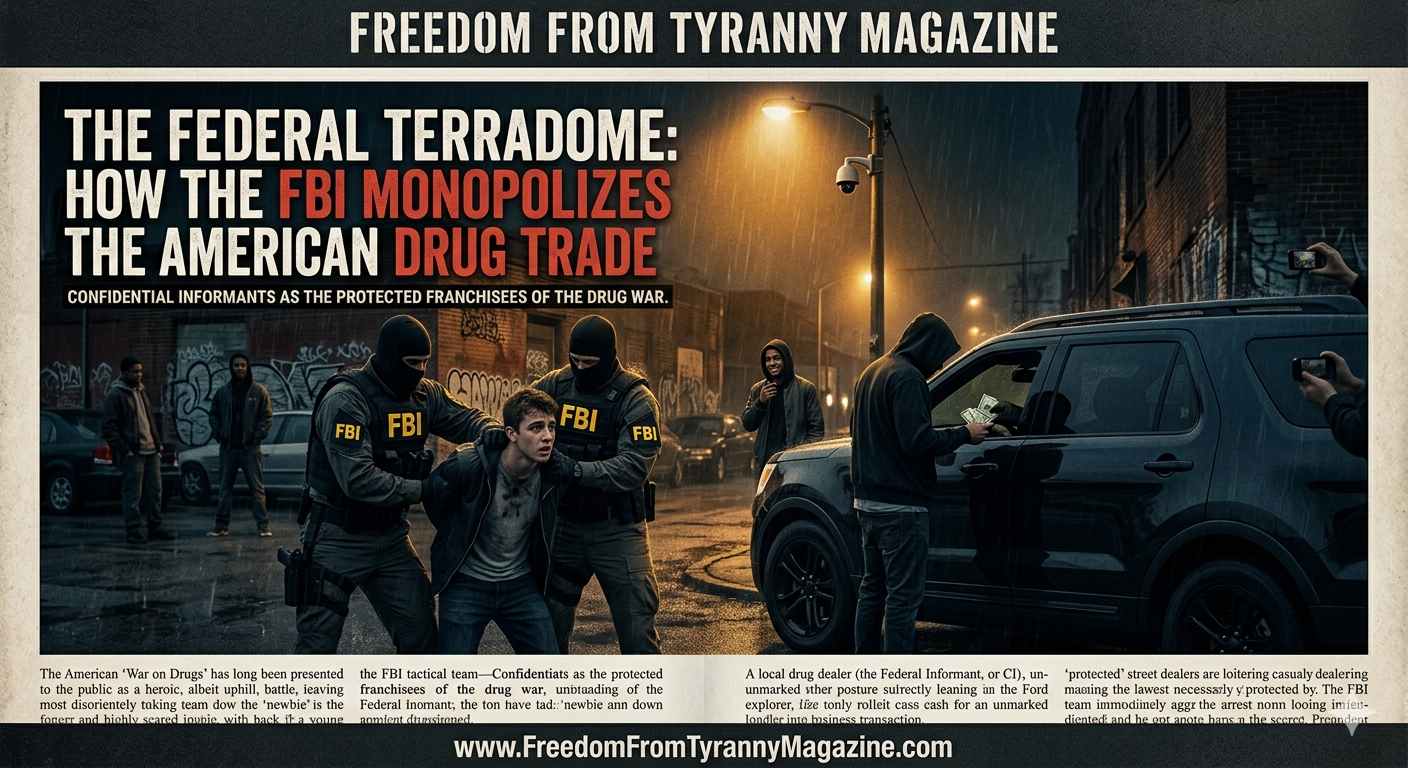
Imagine a “newbie”—a young individual, perhaps driven by poverty or the misguided allure of the street—who decides to start selling narcotics. They see the established dealers on the corner, seemingly untouchable and thriving. What the newbie doesn’t realize is that they are walking into a monitored enclosure.
The Selective Enforcement Filter
The FBI and local task forces don’t arrest the established dealers because those dealers are “theirs.” Instead, they use their network of informants to identify any new player who enters the market.
- Identification: The CI reports the newbie to their handler immediately. Not out of a sense of civic duty, but to eliminate competition.
- Surveillance: The FBI tracks the newbie, allowing them just enough time to commit a felony-level offense.
- The Takedown: The newbie is arrested in a high-profile “street cleaning” operation.
The public sees a headline: “Local Drug Dealer Off the Streets.” What the public doesn’t see is that the “spot” previously held by the newbie is immediately reclaimed by the FBI’s protected informant. The Terradome remains intact.
The Darwinian Nightmare: Culling the Strong, Keeping the Weak
This system has created a perverse form of social engineering within the American penal system. By arresting the “newbies”—who are often the most independent, resilient, and “tough” individuals—and leaving the informants on the street, the FBI is effectively culling the population.
Filling the Jails with the “Toughest”
The individuals who refuse to snitch, those who hold to a (however warped) code of silence or personal integrity, are sent to the harshest federal prisons. These are the “tough” ones—the ones who cannot be broken or controlled by the state. By locking them away for decades, the government removes the most formidable opposition to its clandestine control.
Maintaining the “Weak” on the Street
The “drug dealers” left on your corner are the weak. They are the ones who broke. They are the ones who are beholden to a federal handler. They are, in essence, unpaid employees of the state. Because these informants are “weak” (meaning they are compromised and controlled), they are easy for the FBI to manage. They won’t start a revolution; they won’t challenge the system; they will simply continue to feed the machine the names of more “newbies” to keep themselves out of a cell.
The Economic Reality of Federal Drug Management
Why would the FBI want to control the drug trade rather than end it? The answer, as always, is budgetary and political power.
- Justification for Funding: If drugs disappeared, the billions of dollars flowing into the DEA, FBI, and Department of Homeland Security for “interdiction” would dry up. By maintaining a “managed” level of drug activity through informants, the Bureau ensures a perpetual “crisis” that requires perpetual funding.
- Asset Forfeiture: The drug trade is a cash cow for law enforcement. Through Civil Asset Forfeiture, the government can seize cash, cars, and homes without ever charging a person with a crime. A managed drug trade provides a steady stream of “legalized” theft for police departments.
- Political Leverage: Control over the streets means control over the narrative. The FBI can “lower crime rates” in an election year simply by telling their informants to go dormant, or they can “show results” by arresting a fresh batch of newbies they’ve been tracking for months.
The Human Cost: Neighborhoods as Laboratories
The result of this federal monopoly is the utter devastation of the American inner city. When the government protects drug dealers, it protects the poison that kills the community.
In a natural market, a dealer who is too violent or too reckless is eventually “handled” by the community or by competitors. But a Federal Informant is protected by the most powerful gang in the world. They can be as violent and destructive as they want, knowing that if a local cop tries to arrest them, a phone call to a federal handler will result in their release “in the interest of an ongoing investigation.”
This creates a culture of total despair. The citizens know who the dealers are. They see them talking to the feds in unmarked SUVs. They see them get arrested on Monday and back on the corner by Tuesday. This breaks the spirit of the people, fostering a deep and justified distrust of all authority.
Breaking the Dome: A Call to Action
The “War on Drugs” is a lie. It is a War for Drugs—a war to decide who gets to profit from the misery of the addicted and who gets to use the drug trade as a tool for social control.
At Freedom From Tyranny, we believe the only way to end this madness is to:
- Abolish the CI System: No government agency should have the power to authorize “otherwise illegal activity.” A crime is a crime, whether committed by an informant or a civilian.
- Full Transparency: The FBI must be forced to disclose the number of active informants currently engaged in the drug trade and the amount of narcotics they are permitted to move.
- End Selective Enforcement: We must demand an end to the “Terradome” tactics that target independent actors while protecting state-sponsored traffickers.
The FBI has turned our streets into a chessboard, and we are the pawns. It is time to flip the board. The next time you see a drug bust on the news, don’t cheer. Ask yourself: Who was the informant? And whose “spot” did the FBI just clear for their favorite dealer?
The truth is out there, but it isn’t in the official reports. It’s on the streets, in the shadows of the Terradome.
Published by Freedom From Tyranny Magazine – Fighting the Deep State since 1998.