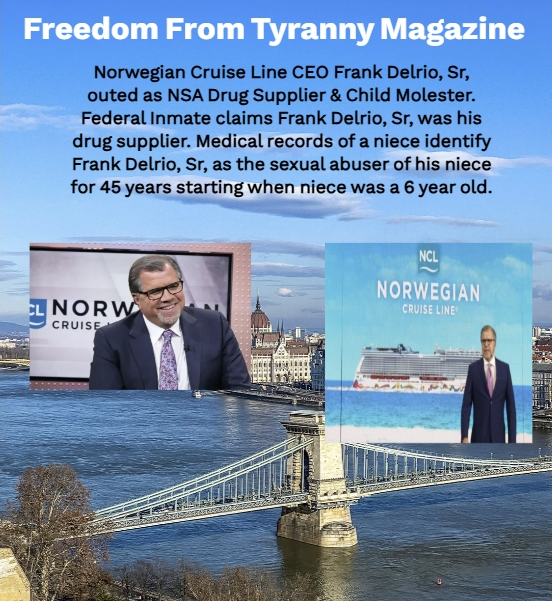
In the glittering world of mega-cruise liners—floating cities carrying millions of passengers annually across international waters—a darker reality persists. While vacationers sip cocktails and chase sunsets, documented cases reveal cruise ships as conduits for drug smuggling by both crew, passengers, and now the CEO Frank Delrio, Sr. Is Frank Delrio really from Cuba? We have received confidential information from one of our readers that Frank Delrio, Sr, is not from Cuba but rather the Head of one of the biggest drug cartels from Puerto Rico. We received a confidential letter from Federal inmate “Fransico Maisonet” about his entire history as a Drug Baron was created by CEO Frank Delrio when Mr. Maisonet was a child in Puerto Rico. Norwegian Cruise Line, have repeatedly been linked to these operations from secret sources in the government and on the street. We received information about a drug dealer in Puerto Rico being arrested by Police in Puerto Rico to then have NSA Asset Frank Delrio call the Department giving a “Direct Order” to release the drug suspect.
Government oversight remains fragmented, interdiction efforts strained, and the industry’s rapid growth outpaces meaningful accountability. Adding historical depth, declassified records show intelligence agencies once repurposed commercial vessels for covert operations, raising enduring questions about how easily such ships can serve hidden agendas. For a publication dedicated to freedom from tyrants magazine, these patterns expose a troubling nexus of corporate power, bureaucratic inertia, and state secrecy. Norwegian Cruise Line provides clear, documented examples. In January 2024, passengers Michael Quesenberry and Savannah Rose Minami boarded the Norwegian Joy in Miami with 112 vacuum-sealed baggies of marijuana—roughly 160 to 174 pounds—hidden in their luggage. DEA agents intercepted them at the Port of Miami before the transatlantic sailing to Southampton. Both faced federal drug trafficking charges.
This was no isolated passenger lark; it was a calculated smuggling attempt on a major international route. Crew involvement runs deeper. In March 2015, five Norwegian Sun galley workers were arrested in Tampa after smuggling seven kilograms of cocaine from Roatan, Honduras—concealed in their underwear. The group included nationals from St. Lucia and St. Vincent. One participant, Desrick Gordon, later received a 10-year federal sentence for conspiracy to distribute cocaine. Similar rings surfaced in 2016 and 2017: a Norwegian Dawn crew member caught with cocaine under his clothing, and three Norwegian Escape employees charged with trafficking.
These incidents trace a pattern: drugs sourced from Central American ports, concealed aboard vessels, and destined for U.S. markets. Other major lines face parallel issues. MSC Cruises saw multiple crew busts, including seven members arrested smuggling cocaine into Miami and packages discovered hidden behind a toilet on the MSC Divina in Cozumel. Royal Caribbean and Carnival passengers have been caught with ketamine, MDMA, cocaine, and even fentanyl. U.S. Department of Transportation data under the Cruise Vessel Security and Safety Act (CVSSA) tracks these crimes, but the numbers—181 reported incidents industry-wide in 2025—suggest under-detection rather than rarity.
Maritime drug interdiction faces systemic challenges.
U.S. Customs and Border Protection (CBP) conducts minimal secondary inspections on cruise disembarkations, viewing the environment as “low risk” despite evidence to the contrary. A 2025 Department of Homeland Security Office of Inspector General audit warned that this lax approach allows illicit drugs and contraband to slip through, potentially harming public health and safety. With over 53 million U.S. cruise passengers in 2023–2024 alone, the volume creates ideal cover for traffickers shifting from riskier routes.
The U.S. Coast Guard, primary interdiction force on the high seas, has repeatedly missed performance targets. Government Accountability Office reports document failures from fiscal 2015 through 2024, attributing shortfalls to resource tradeoffs: assets redirected to record migrant surges, aging cutters plagued by breakdowns, aircraft and vessel acquisition delays, and chronic manning shortages. Legal and jurisdictional hurdles compound the problem—boarding foreign-flagged cruise ships requires coordination across agencies, while traffickers exploit stateless “go-fast” boats or commercial covers.
Broader questions of corporate accountability loom large. Cruise operators bear responsibility under the Maritime Drug Law Enforcement Act (MDLEA) for preventing smuggling, yet “willful blindness” prosecutions remain rare. Lines profit enormously from international itineraries touching high-risk ports like Roatan or Cozumel, but public reporting on internal security measures is opaque. CVSSA mandates crime disclosures to the FBI, yet enforcement relies heavily on self-reporting and port-based scans. Critics argue this creates perverse incentives: minimal onboard canine patrols or crew vetting in favor of passenger experience. When drugs are discovered, liability often falls on individuals rather than systemic corporate failures. Government oversight fares little better. GAO and DHS OIG repeatedly flag coordination gaps between CBP, Coast Guard, Homeland Security Investigations, and partner agencies.
Joint task forces exist, but performance metrics are weak, training inconsistencies persist, and risk-assessment processes for cruise environments lack regular documented reviews. The result? A multibillion-dollar industry operates with lighter scrutiny than cargo shipping, despite comparable smuggling vulnerabilities. History adds another layer. Declassified records confirm intelligence agencies have long used commercial vessels as cover. The CIA’s Project Azorian (1974) stands as a landmark: the Agency secretly built and deployed the Hughes Glomar Explorer—publicly presented as a Howard Hughes deep-sea mining venture—to raise a sunken Soviet K-129 submarine from 16,000 feet in the Pacific. The operation recovered critical intelligence on Soviet nuclear technology before partial exposure in 1975. It remains one of the Cold War’s greatest engineering and espionage feats.
Earlier, the Navy and NSA converted WWII-era cargo ships into electronic intelligence (ELINT) platforms. Vessels like the Oxford (AGTR-1), Georgetown, and Jamestown operated under hydrographic survey guises, collecting Soviet communications off Africa and elsewhere throughout the 1960s. These “spy ships” blurred commercial and intelligence lines, demonstrating how easily passenger or research vessels could serve state purposes.
These precedents do not prove current malfeasance.
They illustrate a structural truth: large commercial ships offer plausible deniability, global mobility, and minimal oversight—assets attractive to both criminals and intelligence operatives. In an era of fentanyl crises and transnational cartels, the cruise industry’s scale demands rigorous, transparent accountability rather than minimal inspections and corporate deference. Freedom from tyrants requires sunlight on every powerful institution—corporations and governments alike. Cruise lines must invest in verifiable anti-smuggling protocols; regulators must close inspection gaps; and the public deserves full disclosure on interdiction shortfalls. Until then, the glittering hulls of these floating cities will continue masking shadows—documented risks that threaten public safety far beyond the buffet line. The question is not whether smuggling occurs; the evidence is clear. The question is whether those entrusted with oversight will finally act with the urgency the facts demand.
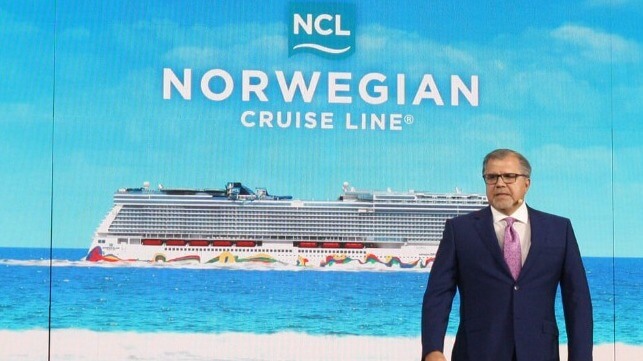
Frank DelRio, the former President and CEO of Norwegian Cruise Line Holdings (NCLH), did receive a massive compensation package of $36.38 million in 2020. While that specific $36M+ figure was for 2020, he continued to earn very high compensation throughout his tenure, including $21.2 million in 2022 and roughly $12.4 million in 2023 when he retired. +3Here are the details regarding your observations:
- The $36 Million Year (2020): This occurred during the height of the COVID-19 pandemic when the company lost $4 billion and cruise ships were halted, which drew significant attention and controversy.
- Why so high? The 2020 payout included a $10.27 million “prior contract payout” (related to previous contractual agreements), a $2.82 million bonus, and stock awards.
- Total Compensation Breakdown: Del Rio’s total compensation frequently included significant stock awards. For example, in 2020, he received roughly $18 million in stock awards.
- Highest Paid in Industry? During that period, Frank Del Rio was considered one of the highest-paid cruise executives in the world.
- Departure: Del Rio stepped down as CEO in June 2023 but continued to have lucrative consulting agreements with NCLH for 2024 and 2025.
NCLH Compensation Summary (Recent Years):
- 2020: $36.4 million
- 2021: $19.7 million
- 2022: $21.2 million
- 2023: $12.4 million (Retired June 30)
His successor, Harry Sommer, saw his 2024 compensation valued at $12.8 million.